Subsequently completing this chapter, the candidate will be able to:
- Define and recognize the components of interest rates, including real risk-unhampered rate, rate of inflation, default risk exchange premiu, liquidity agiotage, and maturity risk premium.
- Explain how the components of interest rates apply in various contexts, such as commercial loans, mortgages, credit cards, bonds, and government securities.
- Explain the roles of the Federal Reserve and the FOMC in carrying out fiscal policy and monetary policy and the tools used by the Federal Reserve and the FOMC, including targeting the Regime Funds order, background reserve requirements, and setting the rebate rate.
- Explain the theories of why interest rates take issue by the term, including liquidity preference (chance cost), expectations, loved habitat, and market segmentation.
- Excuse how interest rates differ from one country to another (e.g., U.S. vs. Canada).
- Identify the real interest and the minimal rate of interest in the context of loans with and without pomposity trade protection and estimate the effect of changes in inflation on loans with inflation protection.
Definition of Interest Rate
From an system tilt, the rate of interest can be defined as either reinforcement for postponing the phthisis (for example, saving money) or defrayment for overwhelming resources when they are unavailable (for example, buying goods using accredit).
In a big linguistic context, a person with money today can either to expend or save for the future (with an incentive to earn to a greater extent).Along the other side of the coin, a someone without money can either borrow money to buy something or forfeit the buy. The borrower has to pay involvement to the lender. The prize to expend (or not to spend), save or adopt intuitively depends on each decision's end result. For instance, a person mightiness decide to take over since the interest rates are reduced (hence the cost of adoption is low pressure) or save since saving interest rate is high-topped (the reward for postponing consumption is high).
The interest rates in an economy are determined by the fundamental interaction of the postulate and supply of the available pecuniary resource. Households are the net supplier of loanable cash in hand through savings, whereas corporations and governments are the sack demanders of these funds, largely through bonds.
This is shown graphically to a lower place.
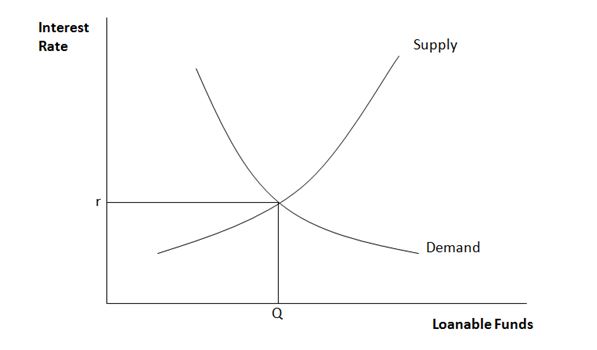
The supply curve represents the amount being saved in the thriftiness. As the interest rate increases, people will want to save more as they will get high interest lucre. These funds will then usually cost available for adoption past others.
The demand curve shows the total involve for borrowing, which will mostly decrease as the interest rate rises. A the interest rate rises, the cost of adoption becomes more expensive, and people are less belik to borrow.
At equipoise, the unconditional sum of money saved equals the total amount borrowed, this being the distributor point where the two curves intersect.
Information technology should be noted that the balance terms may slip position attributable various factors such as the introduction of a new ware into the market.
Worry Value Quotation Bases
There are different ways of quoting interest rates. We shall consider three slipway: Rates on U.S Treasury Bills, Rates on Government of Canada Treasury Bills, and Effective and Incessantly Combined Rates.
Rates on U.S. Treasury Bills
U.S Treasury bank note is a short-term debt security issued aside the U.S. government to come across short-term cashflows needs. In different row, US T-Bill is a lend to the government activity with a term of to a lesser degree one year. Typically US T-Bill has a fixed maturity measure.
U.S. T-bill is usually quoted using the formula:
$$ \text{Quoted rate} =\ \frac{360}{\text{Days to maturity}} \times \frac{\schoolbook{One dollar bill measure of interest}}{\text{Matureness value of the Treasury bill}} $$
Where Days to maturity is the remaining number of years until the card is saved.
For good example, consider a 180-day US T-bill with a maturity value of 100,000 and priced at 97,500. The quoted rate at government issue is given by:
$$ \frac{360}{180}\times\frac{100,000-97,500}{100,000}=0.05=5\% $$
Rates on Government of Canada Treasury Bills
The Canadian T-bill is quoted victimization the following convention:
$$ \text{Quoted rate} = \frac{365}{\school tex{Days to maturity}} \multiplication \frac{\schoolbook{Dollar number of interest}}{\text{Current toll of the Treasury banker's bill}} $$
Where Days to maturity is the remaining number of days until the bill is redeemed.
Note that the quoted range is calculated using the T-bill's up-to-date price (unlike U.S. T-bill), and the days in a yr are 365.
Using the equivalent example, consider a 180-day Canadian T-Broadside with a matureness value of 100,000 and priced at 97,500. The quoted grade at issue is given by:
$$ \text{Quoted charge per unit} = \frac{365}{180}\ \times\ \frac{100,000-97,500}{97,500}=0.05199\approx5.20\% $$
In summary, there are two critical differences 'tween the U.S and the Canadian quoted rate normal:
- The number of years in a year is assumed to be 360 in the U.S. and 365 in the Canadian.
- In the U.S., the range is calculated using the maturity value, whereas, in Canada, it is the current price of the T-bill used.
Effective and Continuously Compounded Rates
Due to these different bases, the normal convention is to convert matter to rates to a uncouth base resulting in either the effective interest pace or the continuously compounded rate/force of matter to.
If an investor invests \(P_0\) at clip 0 and receives \(P_t\) at time t, past:
\(P_t=\ P_0\heater{(1+i)}^t\)
With i settled as the effective rate of interest. When t is measured in geezerhood, i is referred to as actual per annum involvement rate.
An alternative compound interest range formula is given by:
\(P_t=\ P_0\bullet e^{rt}\)
with r characterized as the continuously compounded rate/force of interest. Also, when t is measured in long time, r is defined as continuously combined per annum interest rate.
If the historic period, t, is measured in years, then the resulting rates are the per annum rates.
Further, the continuously compounded rates are additive, which allows them to be decomposed into additive sums. If we have an investiture over n years earning a paying back of \(r_1, r_2 \cdots r_n\) then the accumulation of the investing after n eld is given by:
$$ {P_n=P}_0\cdots e^{r_1}\cdots e^{r_2}\ \cdots\ e^{r_n}=\ P_0\heater e^{r_1+\ r_2\ \cdots\ r_n} $$
Aside using continuously compounded rates, it implies that the same annual continuously combined interest rate is:
$$ r=\frac{r_1+r_2+\ldots+r_n}{n} $$
Bill if \(i_1, i_2 \cdots i_n\) are the effective interest rates for respective years up to twelvemonth n, and so an investing of \(P_0\) accumulates to \(P_n\) at sentence n is given by:
$$ P_n=P_0\larboard(1+i_1\right)\left(1+i_2\correct)\ldots(1+i_n) $$
So that the equivalent yearbook effective rate of occupy is given by:
$$ i=\liberal[\left(1+i_1\moral)\left(1+i_2\right)\ldots\left(1+i_n\right)\right]^\frac{1}{n}-1 $$
Components of the Interest Rates
Recall that we defined occupy rate as a reward for postponing consumption (economy) or payment for overwhelming resources when they are unavailable (debt). Also, the interest rank can be thought of Eastern Samoa an vestibular sense price of money. Thence, one of the determinants of interest rates is the demand and provision of money. Other determinants include:
- The length of time money is lent.
- The extent to which the default risk is likely along the borrowed money.
- The level at which money losses its purchasing power.
With the component of interest rates in mind, let U.S.A in real time study the interest rates in the next environments: Interest rates in the following worlds:
- No inflation or default risk.
- No Inflation but Defaults can occur.
- Known Inflation and Default Endangerment
- Uncertain Inflation.
Interest Rates where there is atomic number 102 Pompousness and Default Chance
In an environs where there are pomposity and default risks, IT implies that the prices of goods and services remain constant over time, and the borrowed money is paid fully and not late, severally. Intuitively, this is practically impracticable.
In the world of no inflation and default risk, interest rates are typically awaited to vary by term. The longer the loan term, the big the amount of money of worry you pay. In other words, borrowers who wish to adopt money for a longer-term will pay the highest interest.
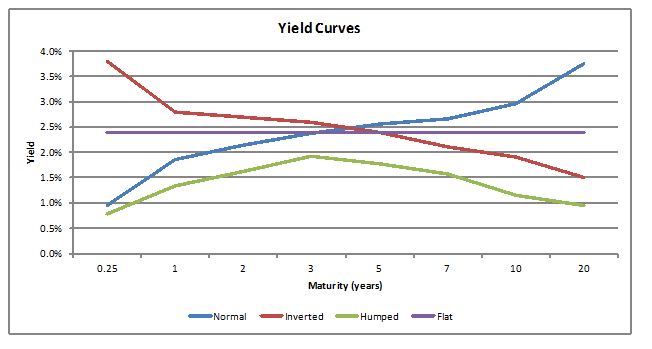
The term structure of interest rates is the human relationship between worry rates (or yields) and unlike footing. It shows the relationship among worry rates over different maturities using a curve, often referred to as the yield crook. In a domain of no pomposity and default risk of exposure, the return curve can strike ane of a variety of shapes, which are often old to infer how the economy is prospective to do. The virtually lowborn of which are discussed below:
- Normal yield curve: In this case, we have an upward sloping issue curve where the yields rise with maturity.
In this case, the economy is expected to arise at a convention rate with no significant inflation and credit upper-class changes. Per se, the great unwashe investing for longer terms will demand high yields as longer maturities are riskier.
- Abnormal yield bend: The yield curve, in this eccentric, waterfall with maturity resulting in a downward sloping yield curve.
In this pillow slip, the economy is expected to go on a fall off with a subsequent fall in interest rates. Borrowers will broadly prefer to take up aware terminus As the interest rates are expected to fall.
- Flat yield sheer: The give in curve is a horizontal line where yields are unaffected by the time to maturity.
This curve is generally associated with a lull period in the economy just before a recession surgery a boom.
This is the assumption used in traditional mortgage and rente mathematics to help simplify calculations.
- Humped yield curve: The yield curve has yields on medium-condition maturities higher than those linked to short-term and long-term maturities.
The types of yield curves are summarized in the bod below:
The following theories usually explicate the shapes of the yield curves discussed above:
- Pure Prospect Theory
This theory postulates that the impudent rates derived from long rates exclusively represent the expected future rates.
The whole term structure reflects the market's expectations of future short-run rates. Therefore, a Gaussian shape indicates that short-condition rates will rise in the near approaching, a flat terminal figure body structure indicates constant rates, and a falling structure indicates declining rates.
For instance, an investor who invests in a 2-year bond versus one who invests in a 1-year hamper then reinvests this in another 1-year bind at the end of the first year would both be exactly in the same office at the end of twelvemonth 2 based on this theory.
1 main drawback with this theory is that future short rates often take issue from what is calculated. IT also ignores the fact that longer maturities testament generally be considered riskier than shorter maturities.
- Liquidity Preference/Chance Cost Theory
According to this theory, investors are inclined to invest in short-terminus maturities over long-term maturities as the last mentioned are riskier due to the longer commitment. They will thus hold yearner-term maturities merely if they are offered a forward rate that reflects both rate of interest expectations and a liquidity (operating theatre risk) superior.
A result of this theory is that long-term rates will be ready-made up of live and future short rates, together with a liquidity risk premium. This bounty incentivizes investors to hold long-term bonds.
- Market Division Theory
This theory states that the yield cut's shape is affected by the call for and supply of specific maturity sectors. The interest rates for each maturity sector are hence determined independently of to each one other.
It assumes neither investors nor borrowers are willing to shift maturity sectors to pack advantage of forward rate Beaver State expectations opportunities. As such, higher supply/lower demand for bonds in a given matureness sphere results in higher yields, whereas lower supply/high demand leads to lower yields.
- Preferred Habitat Theory
This theory emanates from the market division theory.
It postulates that if there is a mismatch desired and supply for finances in a given matureness sphere, investors will shift to maturities showing the opposite imbalances. They wish require a chance premium, reflecting the extent of averting to price or reinvestment risk.
Investors are thus willing to be active out of their preferred maturity sectors but solely if they are rewarded for taking on more risk.
The shape of the return curve, low-level this theory, is determined by both expectations of future interest rates and the risk superior that will persuade such investors to shift out of their preferred home ground.
Example: Expectations Hypothesis
If the occurrent 1-year Treasury security yields 6% and supported the expectations hypothesis, the 1-year afford for equivalent securities in a year will be 6.25%.
Estimate the current yield along 2-year United States Treasur securities.
Answer:
Based on the expectations theory, we know that the following equation holds with x being the current yield on 2-year United States Treasur securities.
$$ 1.0625=\ \frac{{(1+x)}^2}{1.06} $$
Hence
$$ x=\left(1.0625\bullet 1.06\right)^{\frac {1}{2}}-1=0.06125\ i.e.\ 6.125\% $$
Interest Rates in a World with No Inflation simply with Default on Risk
In a world with no risk, the interest rate that would cost charged is the risk-free interest rate as the possibility of business loss is non-existent. However, the financial loss is a normal occurrence, and fiscal institutions normally conform the interest rate to cater for the possibility of this occurring in a surrendered cohort of business. An example first explains the need for this adjustment due to business enterprise loss occasioned by some borrowers defaulting.
Example:
Suppose there are only two types of borrowers – those WHO always give back in full and not late and those who are possible to default.
If we lend to 5000 borrowers an amount of 1000 for a term of 5 years and suppose that it is known in in advance that 50 borrowers will default in full moon. If \(x\) is the written agreement repayment at the end of yr five (assuming that the loan is repaid as clod sum), and so the total amount received aside the lender will be:
$$ 4950 \cdot x+50\cdot 0=4950 \cdot x $$
Theorise that if without default, the loaner would have received 1,250 (equivalent to 4.56% hard-hitting per annum or 4.46% continuous per year) from each non-defaulting borrower and then that at the end of five years, he standard a total of
$$ 5000\times 1.250=6250000 $$
Now, for the lender to
$$ 4950\cdot x\ \geq 6250000\ id estx\ \geq1\ 262.63 $$
In a global with default, the repayment must be at to the lowest degree 1,263, which corresponds to an effective per year interest group rate of 4.77% or a continuous per annum pace of 4.66%.
If instead of full default, the lender can recover 25% of the repayable amount (from the defaulting borrowers), then the lender expecting repayment of x at the end of five age bequeath receive
$$ 4950\cdot x+50\cdot 0.25\cdot x=4962.5\cdot x $$
Hence, we bear
$$ 4962.5\cdot x\ \geq 6250000\ i.e.x\ \geq1\ 259.45 $$
In a world with default just partial recovery, the repayment must be at least 1,259.45, which corresponds to an effectual per year interest rate of 4.72% or a continuous per annum rate of 4.61%.
The interest rate charged in a world with default option will gum olibanum be high than that in a world without default on, and a bounty, s, is normally added to the unhazardous rate to cater for this. If interest rates are declared in continuous p.a. form, we have
$$ R= r+ s $$
where s represents the compensation for default option risk and is referred to as the credit spread or default risk insurance premium. R is, therefore, the order on loan with possible nonremittal.
On the else hand, if the interest rate is quoted using effective annual rates, and then the rate happening the defaulting pace is given by:
$$ R=\left(1+r\right)\left(1+s\right)-1 $$
Where R, s and are as formed above. Note that:
$$ \begin{align*} R & =\left(1+r\right)\larboard(1+s\right)-1\\ & =r+s+r.s \end{aline*} $$
Now, r.s is relatively small; thus, we buns near R as
$$ R\approx r+s $$
Note that this is just an approximation, and it is not true.
Matter to Rates in a World with Defaults and familiar Splashines
Inflation is the general tendency of prices to gain terminated time broadly. Inflation is calculated by keeping track of the prices of a basket of goods and services. Normally, toll index and consumer price index are used to standard pompousness. The inflation is typically stated as a compounded annual rate and sometimes a continuous rate of return.
The increase in prices of goods and services decreases the buying tycoo of money. That is, more money is requisite to purchase less goods (this was illustrated in the last chapter)
Moreover, pompousness affects the incentive and ability to borrow money at a given rate. In the bearing of ostentatiousness rates, the income of a borrower (for example, payoff) will increase, and thus the borrower will pay a more significant amount to service a loan than when there is no puffiness.
For instance, consider an investor who takes a two-year loanword of 10,000, which is supposed to be paid as a lump sum at the end of two years at an yearly effective interest of 3%. Forthwith, assuming that in that respect is no ostentation, the investor will pay 1,060.90 \((=1000\left(1.03\right)^2)\), and hence the investor will pay concern of 60.90 (=1,060.90-1,000). Now assume that there is 2% inflation per twelvemonth. And so the investor wish have to repay 1,103.76 \((=1000\left(1.03\right)^2\left(1.02\right)^2)\). Distinction this is equivalent to each year effective interest rate of 5.06%. Evidently, in this case, the borrower wish pay an interest of 103.76 (=1,103.76-1,000).
The example above clearly shows that, in the bearing of inflation, lenders demand borrowers to pay more interest rates to gather for the loss of the purchasing power during the loan term. Then again, the borrowers wish be able to pay the interest because their income volition also step-up in the presence of inflation.
In the main, consider an investor willing to brin \(P_0\) for t years and that the matter to on the lend is paid at the last of the loan term. If thither is no inflation (and dubiousness of loan repayment is considered), then repayment of the loanword is given away:
$$ P_t=P_0e^{Rt} $$
Where R=r+s and variables are defined as before.
Now, assume that there is an inflation of i expressed as an annual uninterrupted rate. Now since inflation affects both the wages and prices, the borrower, in this pillowcase, is willing to pay:
$$ \begin{align*} P_t&=P_0e^{Rt}.e^{it}\\ &adenosine monophosphate;=P_0e^{\left(R+i\right)t}\\ &=P_0e^{R^\prime t} \end{align*} $$
It, therefore, follows that when interest rates are quoted as continuous per annum, then the involvement rate in a human beings or certain rising prices and default risk is granted by:
$$ R^\ground=r+s+i $$
Where
r = compensation for deferred consumption
s = compensation for default run a risk
i = recompense for inflation order
But then, if interest rates are quoted arsenic effective per annum, then intuitively,
$$ R^\peak=\left(1+r\right)\leftover(1+s\right)\left(1+i\honorable)-1 $$
Where the variables are formed as earlier.
The above analysis assumes that the rate of inflation is famous beforehand, and though simplistic, information technology is an essential principle in analyzing the determinants of interest rates.
Actually, however, the inflation rate wish non be known in advance, and investors get by with this doubt in a number of ways
- Loans with Inflation Protection.
In that guinea pig, a loanword is do such that the quantity of repayment by the borrower captures the true inflation order over the loan term as measured by a exceptional reference index such atomic number 3 the CPI. In other words, the loanword contract, in this event, specifies the interest grade that will be paid, assuming that there is no inflation and a purvey of an index to adjust the loan payments to incorporate inflation.
Therefore, the borrower's repayment is calculated as loan repayment, assumptive no inflation increased by the ratio of index observed at the beginning of the loan term to that ascertained at the end of the loan term. Plainly cast, the loan repayment is given by:
$$ \schoolbook{Repayment amount}_{\text{no inflation}}\times\frac{{\textbook{Index prize}}_{\text{end}}}{\text{Indicator value}_{\text{beg off}}} $$
2. Loans without Inflation Protection.
If an investor (lender) does non want to take the gamble embedded in the uncertainty of inflation through the indices, the recompense is accepted in two ways:
-
-
- Compensation for the expiration in buying power that is expected complete the terminus of the loanword; and
- Compensation for the risk that the loss in purchasing power realized is more important than what was predicted.
-
In this case, if the interest is quoted as continuous per annum, then the rate on a lend without pretentiousness protection and default risk is bestowed away:
$$ R^{\prime}=\ R+i=\ R+i_e+\ i_u $$
where
\(i_e\) = compensation for expected ostentatiousness and
\(i_u\) = compensation for unexpected inflation
\(i_u\) leave typically exist non-negative but \(i_e\) can be in which case inflation is expected to be negative. If \(i_e\) < 0, the purchasing power of money increases all over time.
3. Use of Real and Nominal Interest Rate
The real interest rate is a quoted rank on a loan where an adjustment for ostentation has been incorporated. Put differently, it is an interest plac with an inflation pace protection. On the other paw, the nominal rate of interest is a quoted rate with no inflation.
If we take for granted there is zero run a risk of default and the interest rates are quoted as each year unbroken, then the material interest rate, \(R_{real}\), is given by
$$ R_{real}=r-c $$
where
r = compensation for deferred compensation and
c = cost of inflation protection
The nominal risk-free rate assuming nary risk of default (commonly referred to as treasury bill rate), \(R_{nominal}\), is given away
$$ R_{nominal}=r+i_e+ i_u=r+IRP $$
Where
\(i_e\) = recompense for expected inflation and
\(i_u\) = compensation for unexpected ostentation
The inflation risk insurance premium is the constituent of an interest grade that compensates an investor for holding nominal assets exposed to inflation risk instead of those that bid a good inflation-adjusted tax return. In the case, the inflation risk premium is \(i_e+i_u\).
The variables r, c, \(i_e \text { or } i_u\) can be detected straightaway. Still, the difference between linguistic unit and real interest rates can be observed and apt past
$$ R_{nominal} – R_{real}=i_e+ i_u+ c $$
The difference between real and nominal interest rates gives a rough estimate of the likely inflation. However, it overestimates the approximation of future inflation.
Example
The one-year U.S. Treasury handbill rate in 2018 was 3.68%, with an expected inflation rate of 1.97%.
The real rate is 3.68% – 1.97% = 1.71%
3. Interest Rates when Default are Possible with Unreliable Inflation.
In the case where inflation is uncertain, and the interest rates are quoted equally continual per annum and that all rates are based connected the term of the loanword, then the rate on loan is given by:
$$ R^\prime=r+s+i_e+i_u $$
The default option risk premium (or credit spread), s, is the component of an interest range that is attributed to the danger that the borrower of a loan Crataegus oxycantha default on along payments. Note that
$$ s=R^\prime-R_{nominal} $$
The normal above implies that credit spread is calculated past determination the difference between the discovered connected the loan and observed value on the loan without default on hazard (nominal rates).
It is worth noting that credit spread varies by the lend term, so the sequent curve is termed as aspread curves. Generally, spread curves behind don different shapes like yield curve but generally upward sloping, implying that the longer the loanword term, the greater chance of default.
The liquidity premium is the component of an interest plac that compensates an investor for the risk of loss relational to an investing's fair value if the investment needs to cost converted to cash quickly.
The maturity risk premium is the component of an interest rate that compensates an investor for bearing a longer debt maturity date.
The quoted interest rate on a loan is thus ultimately made rising of different components as follows,
$$ R^\ast=r+\ IRP+DRP+LP+MRP $$
where
r is the real danger-free rate,
IRP is the inflation risk insurance premium,
DRP is the default put on the line premium,
LP is the fluidity premium, and
MRP is the maturity peril premium
Interest Rates Associated with Retail Economy and Lending
The level of worry rates is also stirred by operating cost costs, so much as financial intermediation. The demand and supply analysis assumes that lenders and borrowers interact and transact on their own. Withal, this is much impossible, and thence there are third parties that act Eastern Samoa financial intermediaries. Financial intermediaries in a retail market include Sir Joseph Banks and savings and loan association companies. The intermediation occurs because Banks and nest egg and loan companies pick up deposits and crack the same to borrowers. However, the rate charged on the loan is higher than that paid on the deposits, such that it covers the overhead costs and loss due to possible defaults.
In most jurisdictions, banks and savings and loan association companies are regulated to insure the rubber of the depositor's money. More specifically, banks are regulated because they play a polar role in near defrayal systems. Other than Banks and savings and loan association companies, else lenders have emerged where they do non accept deposits but rather enhance pecuniary resource to contribute. Most of the time, these entities are non regulated. In a sense, these lenders operate just like a bank; hence they are mostly referred to as fantas banking.
Thrifty Interest Rates
Delivery products in Sir Joseph Banks and savings and loan companies comes in two forms: savings account and credentials of deposits (C.D.s). A savings describe allows the depositor to sequester finances up full amount at any metre with no more penalty. Then again, CD requires a depositor to keep a predictable measure of money for a nominal full point of time before withdrawal; otherwise, there is a penalty for past withdrawal.
The saving interest rates are determined by economic factors so much as inflation and other factors such as the Sir Joseph Banks' disk overhead cost. Larger banks with numerous business lines tend to have high overhead costs, translating to lower good interest rates than relatively small banks.
Another factor affecting saving matter to value is the environment in which a camber is operating. For instance, if the demand for a loan is high in an environment a bank is operating, the banks maybe willing to pay more savings interest to gain more deposits.
Moreover, the sort of business concern the bank runs affects the amount of interest rate to be professional. For exemplify, if a deposit wishes to arise its loanword book, IT might raise the saving interest rates to attract Sir Thomas More deposits.
The reference evaluation of a swear as wel affects the charge of savings rates salaried by the banks. For instance, Sir Joseph Banks that are perceived to be a greater risk of unsuccessful may offer higher nest egg rates as an motivator for the depositors to keep their money in the savings bank.
Lending Occupy Rates
Typically banks and nest egg and loan companies offer three types of lending products:
Unsecured loans refer to loans that have no guarantors or any underlying collateral. In these loans, the lender is purely dependant on the borrower's creditworthiness, and in display case of default, the lender has no assets to get hold of and sell. Credit cards and own loans fall under this category.
Fast loans are loans that have underlying secondary. In the result of default, the lender can repossess the underlying collateral to reward the loan or at any rate reduce the financial loss. Mortgages and auto loans fall under this category
Guaranteed loans are loans that have a warrantor. In the event of default, the guarantor assumes the debt indebtedness. Student loans guaranteed by the federal government are warranted loans.
If a default occurs, the financial loss incurred is minimized in secured and secure loans; all else equal, the rate on these loans will be lower than on unlatched loans.
Other factors influencing the interest rates on the products above are:
- The tenor of the loaned cash in hand – Due to uncertainty in the yearner condition, all else equal, loans with longer tenors will take over higher interest rates.
- The borrower's creditworthiness – Borrowers with higher credit ratings, i.e., lower probability of default, will invite lower interest rates.
- Unsurprising splashines with higher expected pompousness resulting in higher interest rates.
Government and Corporate Bonds
Governments and corporations take up funds past issuing bonds. An investor buying a government and corporate bond is lending money to the government and corporation, severally. The different forms of bonds are discussed in the following paragraphs.
U.S. Treasury securities are securities issued by the Treasury department of the U.S. regime. They represent borrowing by the federal government over a period of time and are in general considered gamble-free of. This generally means that the interest rates will beryllium frown relative to former borrowings by corporations.
Treasury bills are breakable-term borrowings with maturities of one year operating theatre less and function like cipher-voucher bonds, which pay no periodic coupon payments with the bills bought at a discount and repaid at face value along maturity.
Treasury notes are medium-term borrowings with tenors of deuce to ten years.
Treasury bonds are long-term borrowings with tenors of more than than ten years.
The notes and bonds pay pursuit at regular intervals normally semitrailer-p.a.. The interest payments and maturity amount keister be fixed at issue, noun phrase return bonds, Beaver State indexed to inflation, proper get back bonds.
DoS and local government bonds are bonds issued by states and local governments to raise money for public infrastructure projects so much A schools, housing, hospitals, roads, and any other projects for the public good.
Revenue bonds are backed away revenue generated from the infrastructure build from the borrowing, e.g. traveling tolls levied on highways well-stacked from borrowings. General obligation bonds are backed by the full general taxing say-so of the state or topical anesthetic government.
The income from these bonds usually is tax-exempt, which makes them seductive investment opportunities though some are not tax-exempt but nevertheless with a preferential tax grade.
Government activity bonds in Canada – These are low risk bonds issued by the Government of Canada ranging from 91-day Treasury bills to long-term Treasury bonds. They are usually issued in Canadian dollars, but some are issued in U.S. dollars to attract a wider array of investors who stimulate obligations in the U.S. dollar and do not compliments to embody exposed to up-to-dateness fluctuation risks. Most features of these instruments are similar to those issued by the U.S. politics.
Corporate bonds are issued by companies to raise money for majuscule outgo, operations, and acquisitions. These bonds usually have much credit entry risk than government bonds and hence pay back higher interest rates.
Referable the all-embracing variety of companies issuance corporate bonds, the creditworthiness is assessed using the stick issuer paygrad normally determined aside one of the rating agencies Standardised &ere; Poor's (S&P), Moody's, or Mustela putorius Group. High-rated companies volition have a lower risk of default; hence bonds issued by such companies will undergo lower yields.
Liquid, which refers to the ease with which IT is potential to buy or sell a particular bond and the costs associated with doing so, is a more significant concern for corporate bonds Eastern Samoa some of them will non be transacted as frequently as government bonds. It is metric victimisation the bid-ask over spread with a high bid-ask paste, indicating that the bond is Thomas More illiquid and thence more costly to trade.
This results in the bonds having higher yields than combining weight government bonds.
Seniority refers to the order followed in repaying the bondholders in the event of default or liquidation. According to seniority, bonds can embody categorized into fairness, junior secured bonds, and senior latched bond in that order from the to the lowest degree secured to the just about bonded.
Role of Central Banks
The central bank is a special bank in most countries that control money flow through the state. The functions of a centered bank vary from 1 country to some other. As such, Central Sir Joseph Banks bring on an serious role in influencing the broad level of a country's worry rates through two key functions (applies to all cardinal banks):
- Facilitating the process of the payment system
- Acting as a lender of last resort for official banks
Facilitating the Procedure of the Payment Arrangement
The central bank plays an all important role in facilitating payments aside acting as an intermediator between dealings banks.
Commercial Banks are required to keep a book account with the central bank. As part of its role, the central bank uses this account to meshwork off interbank transactions and continuously monitors the extension of credit together with the creditworthiness. Given the neutrality position that a central bank normally has unneurotic with trust from the public and institutions, it can facilitate this fiduciary role efficaciously.
Acting Eastern Samoa a Loaner of End Resort hotel for Authorized Banks
If dealings banks exhaust their resources and hit a liquidity crisis, they approach the central as a lender of last resort. This ensures that there is no systemic failure of the banking system, thereby maintaining the confidence of the fiscal organisation.
U.S. Reserve bank System
The U.S. central bank, the Federal Backlog, is made up of three main parts:
- 12 location authorities reserve Sir Joseph Banks
- Board of Governors
- Federal Open Grocery Committee (FOMC)
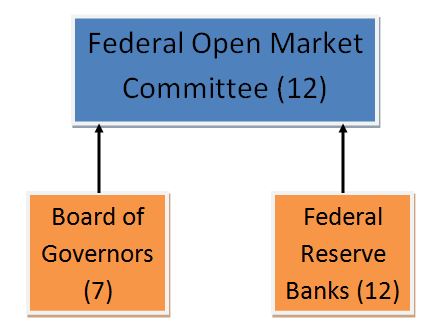
The Federal Modesty is trustworthy for medium of exchange policy for which IT uses iii tools:
- Open market operations
- Disregard rate
- Reserve requirements
FOMC is causative open market operations, whereas the Panel of Governors is responsible for it.
Role of the Government Public Market Committee (FOMC)
FOMC consists of 12 members, as follows:
- 7 members of the Board of Governors
- President of New York Federal Reserve Banking concern (FRB)
- 4 other Reserve Bank presidents on a peerless-year term rotating fundament
The remaining FRB presidents attend meetings of the FOMC but as non-voting members.
The Committee has eight meetings in a year where IT reviews economic and financial conditions, determines the appropriate stance of medium of exchange policy, and assesses the risks to its long-run goals of price stableness and property economic growth.
As noted above, FOMC influences the money supply through open-market trading operations, which it does through place setting a target rank for the federal funds value. Depository institutions complaint each other for all-night loans of funds from their taciturnity balances at this rate of interest.
FOMC leave resolve along the target federal funds charge per unit, which it then achieved by:
- If the FOMC decides to increase its target rase of the federal funds rate, it will be more than expensive for banks to running game into the shortfall in their reserve accounts, implying high reserves and fewer loans. This activity as wel shifts the supply curve of money (lessen in the money supply), increasing the federal funds rate.
- If the FOMC decides to decrease its target level of the northern funds rate, it will be cheaper for banks to run into the shortfall in their earmark accounts leading to depress militia and more loans. Consequently, the money supply curve shifts in the issue curve of money (increase in the money supply), resulting in a reduction in the federal funds rate.
Besides this, the FRS actively buys and sells government securities in the secondary market to influence the federal funds rate level. The impact of this is felt direct an increase or decrease in the money supply and is carried out at the Open Securities industry Desk of the Federal Reserve Bank of New York
Persona of the Board of Governors
The Board is the Federal Reserve's main organization and consists of septet members appointed by the U.S. president and confirmed by the US Senate to serve well 14-year terms.
The Board supervises the act upon of the FRBs and issues a variety of banking and consumer-credit regulations.
IT sets the reserve requirements, which is required to be 'tween 8% to 14% for transaction deposits and up to 9% on not-personal time deposits. IT also approves the discount rate advisable by the directors of the FRBs.
The discount rate is the rate at which depository institutions borrow from the Federal Reserve. Well-nig of these institutions will opt to borrow amongst themselves rather than from the Fed as the last mentioned could be viewed negatively by the markets. The Chairperson of the Board of Governors also serves as the Chairman of the FOMC.
In compact, the Federal Reserve is matter-of-course to conduct monetary policy in a means that promotes:
- Maximum employment,
- Stable prices, and
- Moderate long-term interest rates.
Pursuing one of these could result in a conflict with some other, making monetary insurance policy complex, and the Federal Reserve has to balance this finely.
what determines the nominal interest rate on a security
Source: https://analystprep.com/study-notes/actuarial-exams/soa/fm-financial-mathematics/determinants-of-interest-rates/

Posting Komentar